Holland Fabric Manufacturing Process: Knitting, Raising, Dyeing & Lamination
Step-by-step industrial walkthrough: Karl Mayer warp knitting machines, brushing cylinders, 130°C pressure dyeing, and stenter heat-setting.
Read Full Guide →The international technical guide to Holland fabric: warp-knitting machines, brushing, piece dyeing, composite lamination, and technical specs. Hosted by Emm Emm Velvet Panipat.
Laboratory-tested metrics ensuring durability, color retention, and structural longevity for furniture makers and drapers.
| Parameter | Laboratory Test Standard | Technical Specification Value | Commercial Impact |
|---|---|---|---|
| Base Fibre Structure | ISO 1833 Quantitative Fibre Analysis | 100% Pure Virgin Grade Polymers / Natural Cellulosic | Zero pilling, high tensile stability under load |
| Finished Weight (GSM) | ISO 3801 Fabric Mass Determination | 400 GSM ± 5% | Heavy drape, opulent handfeel, rich pile depth |
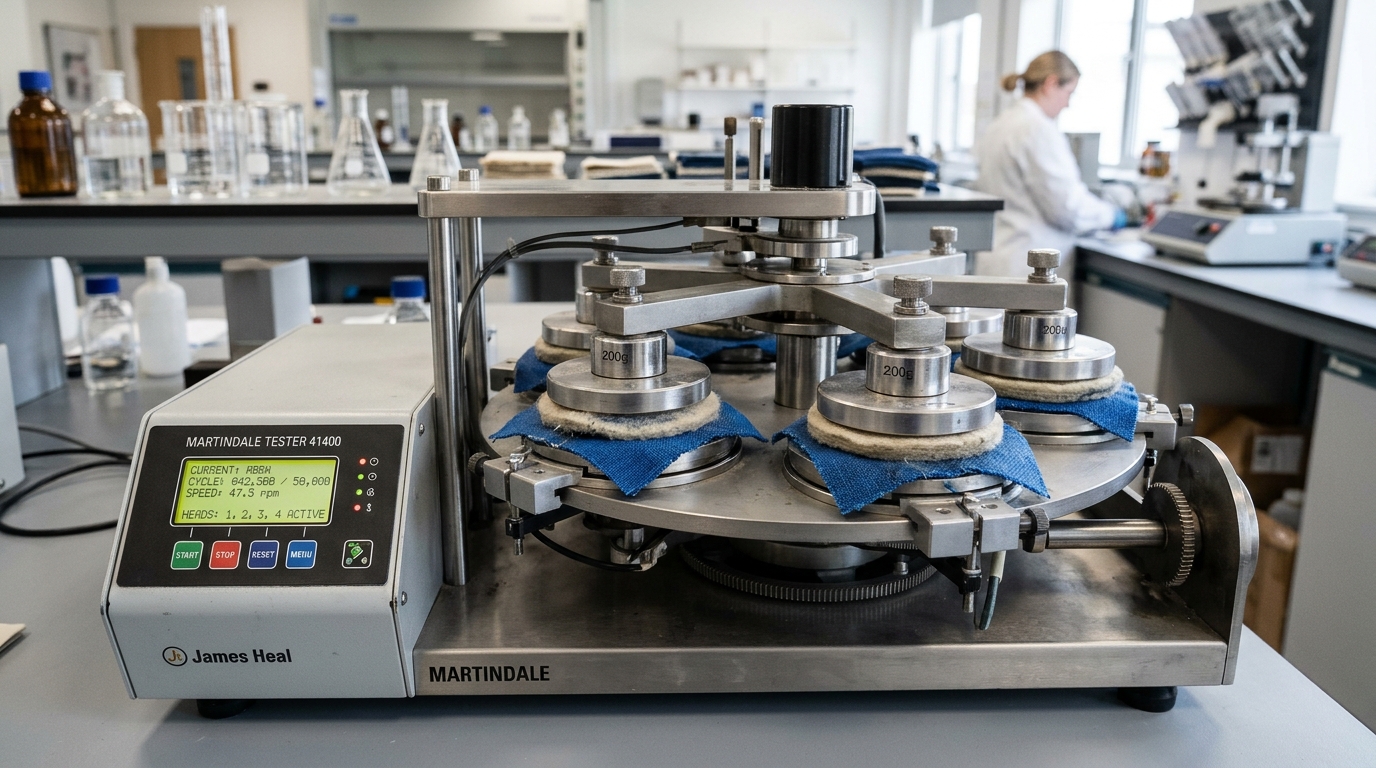
| Abrasion Resistance | ISO 12947-2 (Martindale 12 kPa) | 45,000 – 60,000 Double Rubs | Heavy commercial hospitality & family traffic rating |
| Seam Slippage Resistance | ISO 13936-2 (6mm Seam Opening) | Warp: >250 N | Weft: >220 N | Prevents seam splitting on tight tufted sofa corners |
| Color Fastness to Light | ISO 105-B02 Xenon Arc Lamp | Grade 5 (Blue Wool Scale) | Resistant to fading from window UV exposure |
| Roll Width & Cut Usable | Standard Mill Gauge | 142 cm (56 Inches) Usable | Optimized for standard 3-seater and armchair cutting yields |
Configure yarn denier (50D/75D DTY), pile height, and composite backing type to calculate resulting GSM, tensile strength in Newtons, and Martindale abrasion resistance.
Instant calculation based on Emm Emm Velvet Panipat laboratory data.
Deep, saturated hues formulated with high-temperature piece dyeing for permanent colorfastness.
Backed by three decades of textile precision, Emm Emm Velvet (Est. 1995) combines traditional weaving craftsmanship with advanced European finishing calendars.
From computerized yarn preparation and tension-calibrated weaving to high-temperature jet dyeing, our Panipat mill delivers consistent lot-to-lot shade matching and uncompromising tensile durability.
Call Panipat Mill Direct
Deep dive into fiber science, maintenance tutorials, and architectural upholstery tips.
Step-by-step industrial walkthrough: Karl Mayer warp knitting machines, brushing cylinders, 130°C pressure dyeing, and stenter heat-setting.
Read Full Guide →
Technical exploration of E28/E32 gauge multi-bar tricot knitting, loop formations, tensile warp tension, and zero-fray structural stability.
Read Full Guide →
Complete architectural spec sheet: evaluating 50D/75D DTY micro-polyester, pile height calibration, TC vs fleece bonding, and abrasion tests.
Read Full Guide →
How designers apply Holland fabric across residential, hospitality, and acoustic spaces for durable pet-friendly elegance.
Read Full Guide →Authoritative answers on durability, cleaning methods, and upholstery engineering.
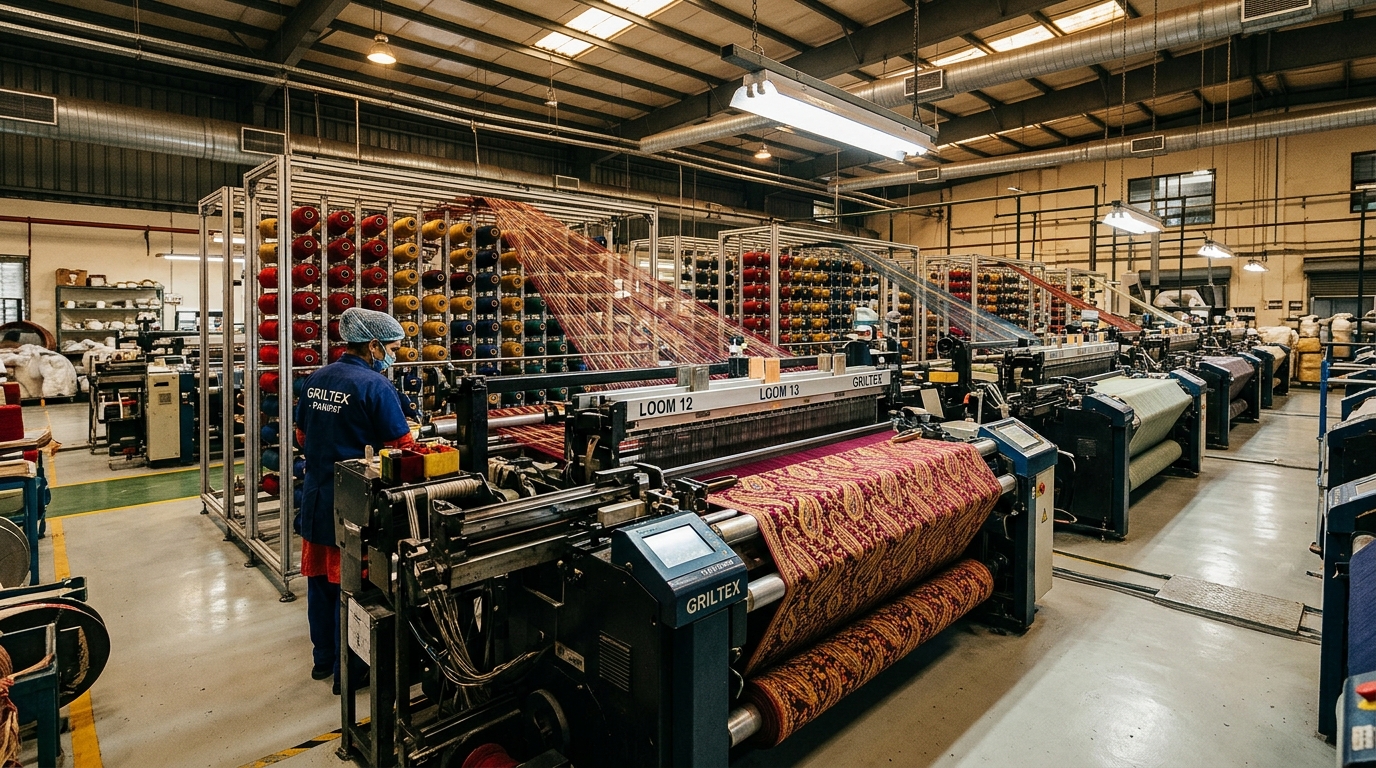
Holland fabric is produced on high-speed multi-guide-bar warp knitting machines (such as Karl Mayer Tricot E28 or E32 gauge). These machines form interlocking loops at speeds up to 2,500 courses per minute, creating a stable, ladder-resistant base ground with continuous upright pile loops.
After warp knitting, the greige fabric passes through precision napping / raising cylinders covered in micro-wire teeth. These teeth gently tease and brush the surface loops into an ultra-soft vertical micro-fiber pile, followed by high-speed rotary shearing to calibrate an exact uniform pile height (0.8mm to 1.5mm).
The sheared fabric is dyed in high-temperature, high-pressure overflow jet dyeing vessels at 130°C using disperse dyestuffs for exceptional colorfastness. It is then dried and thermo-stabilized on multi-chamber stenter frames at 180°C to lock dimensional stability and eliminate shrinkage.
Warp-knit fabric inherently possesses elasticity. To make it suitable for tight sofa upholstery where dimensional stiffness is mandatory, a composite backing (such as TC mesh, spunbond non-woven, or brushed polar fleece) is bonded to the reverse side using hot-melt polyurethane adhesives.
Export-grade Holland fabric is graded using the internationally recognized 4-Point System (ASTM D5430). Fabric rolls must show zero needle lines, oil stains, or shading variations, achieving Grade 4/5 colorfastness to rubbing and exceeding 45,000 Martindale abrasion cycles.
Yes. When laminated with a lightweight backing, Holland fabric drapes with heavy, fluid elegance, offering excellent light filtration and thermal insulation. Its flame-retardant treated variants are also widely used for luxury automotive headliners and door panel inserts.